AI & Automation
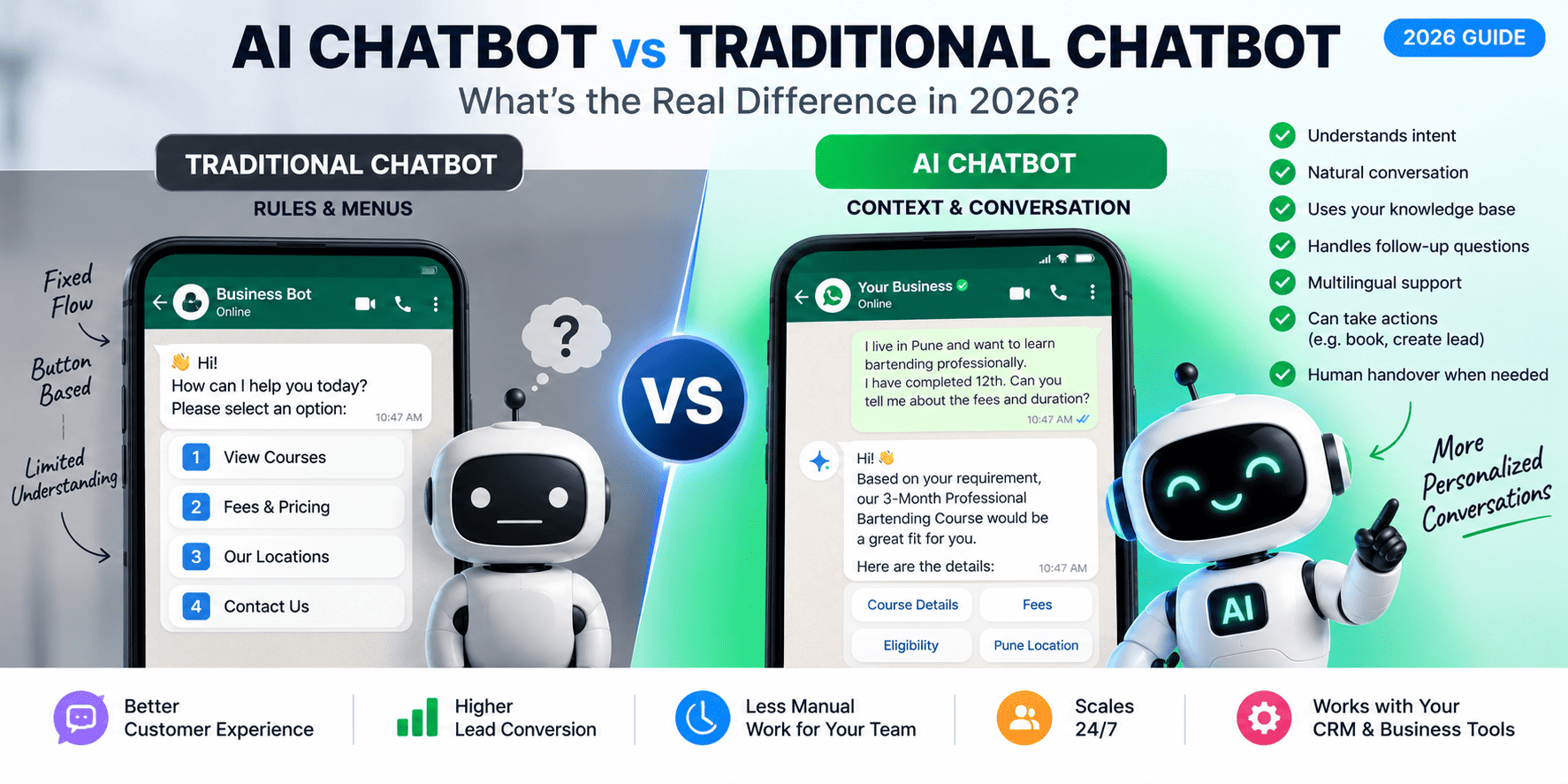
AI Chatbot vs Traditional Chatbot: What’s the Real Difference in 2026?
Traditional chatbots follow predefined flows, while AI chatbots can understand intent, context, and natural language. Learn the real differences, limitations, costs, and where each approach makes sense for your business.
AI Chatbot vs Traditional Chatbot: What’s the Real Difference in 2026?
You've probably interacted with both.
One chatbot says:
"Please select an option."
Products
Pricing
Support
Contact Us
Another lets you simply type:
"I run a small real estate company with 15 employees. We currently manage leads in Excel and WhatsApp. Can you help us automate this?"
And responds based on what you actually asked.
Both are called chatbots.
But they work very differently.
As AI becomes part of more customer-support and sales systems, businesses are increasingly asking:
Do we need an AI chatbot, or is a traditional chatbot enough?
The answer isn't always AI.
Let's understand the difference.
What Is a Traditional Chatbot?
A traditional chatbot generally follows predefined rules, menus, keywords, or conversation flows.
For example:
Bot: How can I help you?
Check Order
Pricing
Support
Talk to Human
If the customer selects 2, the chatbot opens the pricing flow.
These bots are sometimes called:
-
Rule-based chatbots
-
Menu-based chatbots
-
Decision-tree chatbots
-
Scripted chatbots
They're predictable because developers define what should happen at every step.
What Is an AI Chatbot?
An AI chatbot is designed to understand natural-language conversations.
Instead of forcing users to choose from predefined options, it can interpret what they're asking.
For example:
Customer: "I want to join your professional bartending course in Pune. I've completed 12th. Can you tell me the fees and duration?"
An AI chatbot can potentially understand:
-
Intent: Course enquiry
-
Course type: Professional bartending
-
Location: Pune
-
Education: 12th completed
-
Questions: Fees + Duration
It can then retrieve the relevant information from the business knowledge base and generate an appropriate response.
The customer doesn't need to learn how the chatbot works.
The chatbot tries to understand how the customer communicates.
Traditional Chatbot vs AI Chatbot
Here's a simple comparison.
| Feature | Traditional Chatbot | AI Chatbot |
|---|---|---|
| Conversation Style | Menu/Rule Based | Natural Language |
| Understands Intent | Limited | Stronger |
| Handles Different Phrasing | Limited | Better |
| Conversation Context | Limited | Can Maintain Context |
| Predefined Flows | Excellent | Possible |
| Knowledge Base | Usually Fixed Responses | Can Retrieve Relevant Knowledge |
| Follow-Up Questions | Predefined | Dynamic |
| Multilingual Support | Requires Configuration | More Flexible |
| Predictability | Very High | Lower |
| Risk of Incorrect Generated Answers | Low | Higher Without Guardrails |
| Complex Conversations | Limited | Better Suited |
| Cost/Complexity | Usually Lower | Usually Higher |
The important point is:
AI isn't automatically better.
Each approach solves different problems.
1. Rules vs Intent
Traditional chatbots depend heavily on rules.
For example:
IF: Customer selects "Pricing"
THEN: Show pricing information.
That's reliable.
But what happens if someone writes:
"How much will this cost me?"
Or:
"What's the fee?"
Or:
"Kitne ka hai?"
Or:
"Mujhe price bata do."
A traditional system may require developers to anticipate these variations.
AI models are better at recognizing that these messages may all have the same underlying intent:
The customer wants pricing information.
2. Understanding Conversation Context
Imagine this conversation:
Customer: Do you have a branch in Pune?
AI: Yes, we have a Pune location.
Customer: What courses are available there?
The second message doesn't mention Pune.
But a conversational AI system can use the previous message as context and understand that "there" refers to Pune.
Now imagine the customer asks:
"What is the fee for the 3-month one?"
Again, the chatbot needs previous conversation context to understand what "the 3-month one" means.
This is where conversational context becomes important.
3. Different Customers Ask the Same Question Differently
Businesses often create FAQ lists like:
Question: What is your refund policy?
But real customers don't always use those exact words.
They might ask:
"Can I get my money back?"
"What happens if I cancel?"
"Is the payment refundable?"
"Refund milega kya?"
These questions may all relate to the same policy.
An AI chatbot can understand semantic meaning rather than relying only on exact keyword matches.
4. Knowledge Base Matters More Than Most Businesses Think
An AI chatbot doesn't magically know your business.
It needs reliable information.
A business knowledge base might contain:
-
Products
-
Services
-
Prices
-
FAQs
-
Policies
-
Course information
-
Locations
-
Eligibility requirements
-
Working hours
-
Internal instructions
When a customer asks something, the system can retrieve relevant information and use it to generate a response.
This is why AI chatbot quality isn't only about choosing the latest AI model.
A powerful model with a poor knowledge base can still provide a poor customer experience.
5. What Happens When the Answer Isn't Available?
This is one of the most important parts of a production AI chatbot.
Imagine someone asks:
"Do you provide accommodation for students at your Pune branch?"
But your knowledge base doesn't contain that information.
The wrong approach is for AI to guess.
A better response would be:
"I don't have confirmed information about accommodation at the Pune branch. Our team can help you confirm that."
The system can then:
-
Record the unanswered question.
-
Store the conversation context.
-
Notify the appropriate team.
-
Allow a human to answer.
-
Add the verified answer to the knowledge base if appropriate.
This creates a feedback loop where the chatbot improves over time.
6. Multilingual Conversations
Customers don't always communicate in perfect English.
Especially on channels like WhatsApp, conversations may look like:
"Mala course badal information pahije."
Or:
"Mujhe fees aur timing bata do."
Or even a mixture:
"Pune branch ka professional course kitne months ka hai?"
AI systems can often handle multilingual and mixed-language conversations more naturally than rigid menu systems.
However, this still requires testing.
Language support can vary depending on the AI model, business terminology, spelling, and knowledge-base quality.
7. AI Chatbot Doesn't Mean Giving ChatGPT Your WhatsApp
This is an important distinction.
A production business chatbot needs much more than an AI model.
You may need:
-
Business knowledge base
-
Agent instructions
-
Conversation history
-
Customer records
-
Authentication
-
API integrations
-
CRM integration
-
Human handover
-
Logging
-
Analytics
-
Guardrails
-
Unanswered-question handling
-
Monitoring
-
Cost controls
The AI model is only one part of the system.
The real value comes from connecting intelligence with business processes.
8. Chatbots Should Be Able to Take Actions
Answering questions is useful.
Taking actions is much more powerful.
Imagine a customer says:
"Book an appointment for Friday afternoon."
Instead of replying with instructions, the chatbot could potentially:
-
Check availability.
-
Ask for the preferred time.
-
Collect customer details.
-
Create the appointment.
-
Send confirmation.
-
Schedule a reminder.
Similarly, a chatbot could:
-
Create a lead
-
Check order status
-
Update a CRM
-
Raise a support ticket
-
Send a document
-
Schedule a meeting
-
Notify an employee
At that point, the chatbot becomes more than a question-answer system.
It becomes part of the workflow.
9. Human Handover Is Still Essential
Not every conversation should stay with AI.
A customer may:
-
Ask something complex
-
Become frustrated
-
Need negotiation
-
Request a human
-
Have an unusual problem
-
Ask something outside the knowledge base
A good chatbot should recognize when human involvement is needed.
When a human takes over:
AI → Paused
The employee handles the conversation.
When appropriate:
AI → Resumed
This creates a practical hybrid system.
10. AI Can Summarize Before Human Handover
Imagine a customer has exchanged 30 messages with your chatbot.
Then the conversation is transferred to an employee.
The employee shouldn't need to read everything before responding.
AI can generate something like:
Customer: Pratiksha
Location: Pune
Interested In: 3-Month Professional Bartending Course
Questions Asked: Fees, eligibility, location
Status: Needs additional information from Academy team
The employee immediately understands the situation.
The customer doesn't have to repeat everything.
Where Traditional Chatbots Are Better
After reading about AI capabilities, it can be tempting to replace every chatbot with AI.
That's unnecessary.
Traditional chatbots are excellent when the workflow is predictable.
For example:
Select your language.
Enter your order number.
Choose your department.
Confirm your appointment.
These interactions don't necessarily require AI.
Traditional bots can provide:
-
Lower complexity
-
Predictable behavior
-
Lower operating costs
-
Easier testing
-
Deterministic outcomes
If five buttons solve the problem perfectly, you probably don't need an AI model to decide which button the customer wants.
Where AI Chatbots Make More Sense
AI becomes useful when:
-
Customers ask questions in many different ways.
-
Conversations require context.
-
You have a large knowledge base.
-
Customers communicate in multiple languages.
-
You receive many repetitive enquiries.
-
Lead qualification requires conversation.
-
Users don't want to navigate complicated menus.
-
Your workflow requires dynamic follow-up questions.
The more unpredictable the conversation, the more useful conversational AI can become.
The Risk of AI Hallucinations
AI chatbots introduce a problem traditional bots generally don't have:
They can generate incorrect information.
For example, an AI chatbot could potentially invent:
-
A price
-
A policy
-
A feature
-
A location
-
A discount
-
A delivery timeline
That's unacceptable for many businesses.
This is why production AI systems need guardrails.
A useful rule is:
If the information isn't available or confidence is low, don't guess.
Ask for clarification or transfer the conversation to a human.
What About Cost?
Traditional chatbots are generally cheaper to operate because their logic is predefined.
AI chatbots may involve ongoing costs for:
-
AI models
-
Embeddings
-
Vector search
-
Infrastructure
-
Conversation storage
-
Monitoring
-
API integrations
However, cost shouldn't be evaluated only per message.
Businesses should also consider:
-
Employee hours saved
-
Response time
-
Number of enquiries handled
-
Lead conversion
-
Support workload
-
Customer experience
The cheapest chatbot isn't necessarily the one with the lowest API bill.
The Best Approach May Be Hybrid
In many real-world systems, I wouldn't choose:
Traditional Bot OR AI Bot
I'd combine them.
For example:
Use predefined flows for:
-
Authentication
-
Payments
-
Confirmations
-
Important structured actions
Use AI for:
-
Understanding questions
-
Knowledge-base answers
-
Lead qualification
-
Natural conversation
-
Summaries
Use humans for:
-
Negotiation
-
Exceptions
-
Sensitive situations
-
Complex problems
-
High-value conversations
This provides the flexibility of AI without giving up the predictability of structured workflows.
Don't Start With "We Need an AI Chatbot"
Start with the business problem.
Ask:
-
What questions are customers asking?
-
How many conversations happen every day?
-
Where is the team spending time?
-
Which questions are repetitive?
-
Which actions can be automated?
-
Where is human judgment required?
-
What happens when AI doesn't know the answer?
Then design the system around those answers.
Sometimes you'll need AI.
Sometimes a simple rule-based chatbot will work perfectly.
Sometimes you need both.
Final Thoughts
Traditional chatbots made businesses available through automated conversations.
AI chatbots are making those conversations more flexible.
The biggest difference isn't that one has buttons and the other has AI.
It's that traditional chatbots primarily expect customers to follow a predefined path.
AI chatbots can try to understand the path the customer is already taking.
But flexibility introduces uncertainty.
That's why the strongest business systems combine:
AI intelligence
Structured workflows
Reliable business knowledge
Human judgment
Don't add AI simply because it's popular.
Use it where understanding natural conversation creates measurable value.
And where a simple button works perfectly?
Keep the button.
Featured Image Text
AI CHATBOT vs TRADITIONAL CHATBOT
What's the Real Difference?
Rules & Menus → Context & Conversation
2026 Business Guide

Ankiit Janggid
Technical consultant and developer focused on engineering guidance, APIs, AI, and scalable product delivery.
View profile