AI & Automation
AI Voice Agents vs Traditional IVR: What Should Businesses Use in 2026?
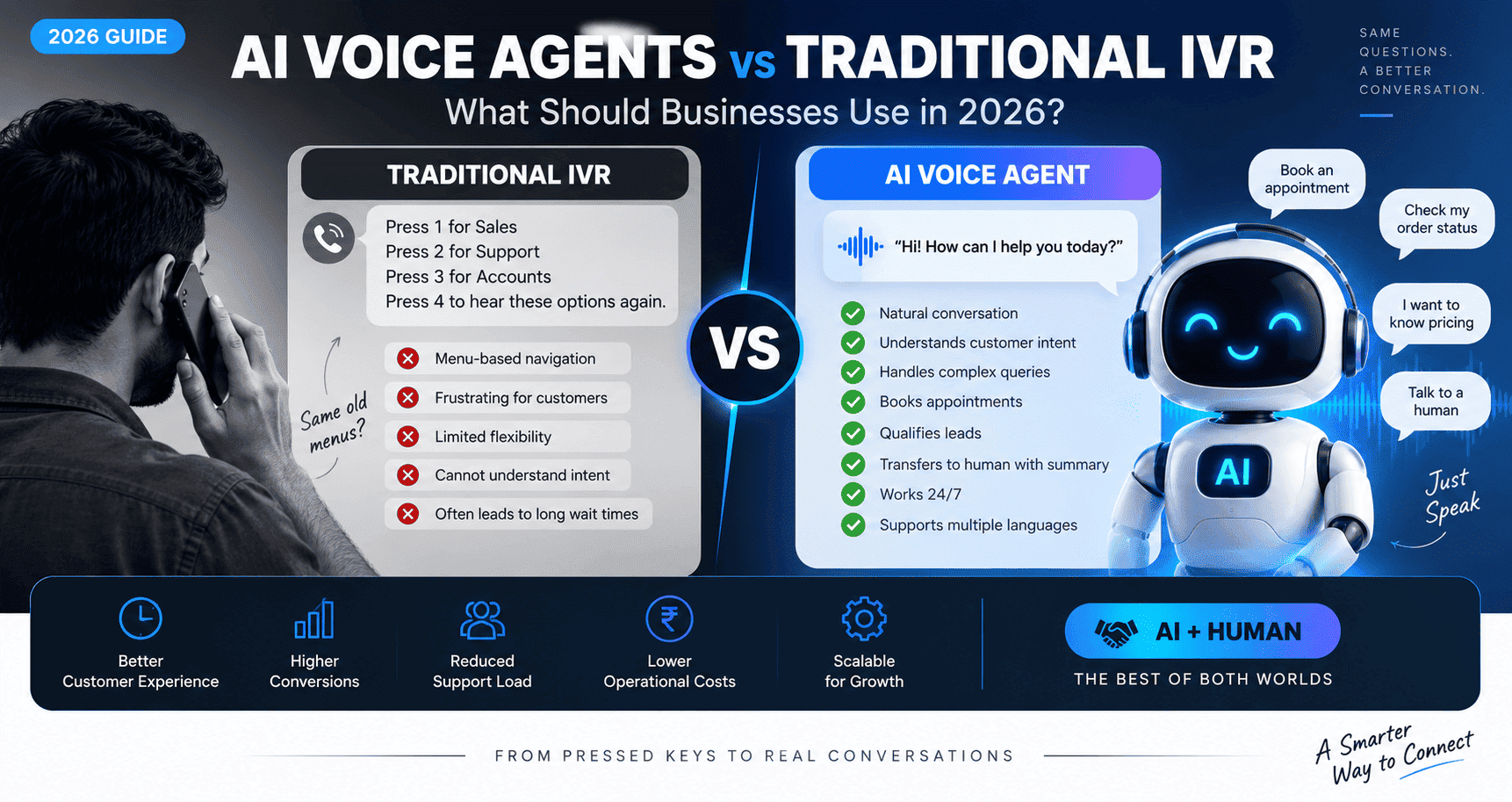
Traditional IVR makes customers navigate menus, while AI voice agents allow them to simply speak. Compare their capabilities, costs, limitations, and use cases to decide which approach makes sense for your business.
ress 1 for Sales. Press 2 for Support. Press 3 for Accounts. Press 9 to hear these options again."
We've all experienced it.
You call a business with one simple question, but before you can get an answer, you're navigating through multiple menus.
For years, Interactive Voice Response (IVR) has been one of the most common ways businesses automate incoming calls.
But AI voice agents are changing what an automated phone conversation can look like.
Instead of asking customers to press buttons, businesses can now simply ask:
"Hi, how can I help you today?"
The customer speaks naturally, and the system understands what they're trying to do.
Does that mean traditional IVR is dead?
Not necessarily.
Let's understand the difference and where each approach makes sense.
What Is Traditional IVR?
IVR stands for Interactive Voice Response.
It's the automated system you hear when calling many banks, telecom companies, hospitals, and customer-support centers.
A typical IVR sounds like:
Press 1 for Sales.
Press 2 for Support.
Press 3 for Billing.
The customer navigates through predefined menus until they reach the appropriate department or action.
IVR works well because it's predictable.
The business defines exactly what options are available and where each option leads.
But that predictability is also its biggest limitation.
What Is an AI Voice Agent?
An AI voice agent allows customers to interact with a business using natural conversation.
Instead of:
"Press 2 for appointment booking."
The customer can simply say:
"I'd like to book an appointment for tomorrow afternoon."
The system can understand the request, ask follow-up questions, check available information, and potentially complete the task.
Modern voice-agent systems can combine:
- Speech recognition
- Artificial intelligence
- Text-to-speech
- Business knowledge
- APIs
- CRM integrations
- Workflow automation
This turns the phone call from a menu-navigation experience into a conversation.
IVR vs AI Voice Agent: Quick Comparison
| Feature | Traditional IVR | AI Voice Agent |
|---|---|---|
| Interaction | Keypad/Menu Based | Natural Conversation |
| Understands Intent | Limited | Yes |
| Handles Open Questions | Limited | Yes |
| 24/7 Availability | Yes | Yes |
| Lead Qualification | Basic | Advanced |
| Appointment Booking | Possible | Conversational |
| Outbound Calls | Limited/Scripted | Conversational |
| Multiple Languages | Possible | Possible |
| Human Transfer | Yes | Yes |
| Conversation Summary | Limited | Can Be Generated |
| Flexibility | Low | High |
| Predictability | Very High | Lower than IVR |
Neither system wins every category.
They solve slightly different problems.
1. Natural Conversations
The biggest difference is how customers interact with the system.
Traditional IVR requires customers to understand the menu.
AI voice agents try to understand the customer.
For example:
Traditional IVR
Press 1 for a new appointment.
Press 2 to reschedule an appointment.
Press 3 to cancel an appointment.
AI Voice Agent
AI: "How can I help you?"
Customer: "I have an appointment tomorrow, but I need to move it to Friday."
The customer doesn't need to figure out which menu option matches their situation.
They simply explain the problem.
2. Inbound Customer Support
Many incoming business calls involve repetitive questions.
For example:
- What are your working hours?
- Where are you located?
- What's the price?
- Is this service available?
- What's my order status?
- Can I book an appointment?
- Can I speak to someone?
Traditional IVR can route these calls.
An AI voice agent can potentially answer them directly.
That means fewer basic calls need to reach the support team.
3. Outbound Calls
This is where AI voice agents can open additional possibilities.
Businesses often make outbound calls for:
- Lead follow-ups
- Appointment reminders
- Customer feedback
- Payment reminders
- Event notifications
- Offer announcements
- Customer re-engagement
Traditional automated calls usually play a recorded message or follow a fixed flow.
An AI voice agent can potentially have a two-way conversation.
For example:
AI: "Hi Rahul, I'm calling regarding your appointment tomorrow at 4 PM. Would you like to confirm it?"
Customer: "Can you move it to Saturday?"
The agent can then continue the conversation instead of ending the workflow.
4. Lead Qualification
Imagine your business receives hundreds of inquiries.
Your sales team currently calls every lead and asks:
- What are you looking for?
- What's your budget?
- Where are you located?
- When do you need the service?
- Would you like to speak with our sales team?
An AI voice agent can handle the initial qualification process.
The sales team can then focus on leads that are genuinely interested.
AI handles the first layer.
Humans handle the conversations where their experience matters most.
5. Human Transfer Is Still Important
One mistake businesses can make is trying to automate every conversation.
Not every call should stay with AI.
Customers may:
- Become frustrated
- Ask something complex
- Request a human
- Have an unusual problem
- Need negotiation
- Require sensitive assistance
A good AI voice system should recognize when automation is no longer helping.
Then it should transfer the conversation.
Don't Just Transfer the Call—Transfer the Context
This is where AI can improve the traditional call-transfer experience.
Imagine a customer has already spent three minutes explaining their problem.
Then they're transferred to a human.
The first thing the human asks is:
"How can I help you?"
Now the customer has to explain everything again.
Instead, the AI can generate a short summary such as:
Customer: Rahul Sharma
Reason: Wants to reschedule appointment
Current appointment: Tuesday, 4 PM
Preferred time: Saturday morning
Status: Needs human assistance
The human agent receives the context before taking over.
The customer doesn't have to start from zero.
6. Multilingual Conversations
For businesses operating in multilingual markets, voice AI can be particularly interesting.
Customers may prefer speaking in:
- English
- Hindi
- Hinglish
- Regional languages
Depending on the underlying speech and voice technology, AI agents can support multiple languages and even switch languages during a conversation.
However, businesses should test this carefully.
Names, addresses, accents, numbers, and industry-specific terminology can still be challenging for voice systems.
7. Call Summaries and CRM Updates
After a traditional phone call, someone often needs to manually update the CRM.
For example:
Customer interested. Follow up Friday. Budget ₹50,000. Wants demo.
AI can potentially generate this automatically.
After the call, the system can create:
- Call summary
- Customer intent
- Lead status
- Follow-up date
- Important notes
- Conversation outcome
That information can then be pushed into a CRM or internal system.
This reduces administrative work after every call.
8. 24/7 Availability
Both IVR and AI voice agents can operate around the clock.
But their capabilities are different.
An IVR can route calls or provide predefined information.
An AI agent can potentially continue the conversation and complete certain actions.
For businesses receiving calls outside normal working hours, this can help capture opportunities that might otherwise be missed.
Where AI Voice Agents Can Fail
AI voice technology is powerful, but it isn't perfect.
Businesses need to consider problems such as:
- Speech recognition errors
- Background noise
- Strong accents
- Unusual customer requests
- Incorrect interpretation
- Latency
- Integration failures
- AI-generated incorrect answers
A voice agent that takes too long to respond can feel unnatural.
An agent that confidently gives incorrect information can be worse than having no automation at all.
That's why testing, guardrails, monitoring, and human escalation are important.
When Traditional IVR Is Actually Better
There are situations where AI would simply add unnecessary complexity.
Imagine the customer only needs to choose between three departments:
Press 1 for Sales.
Press 2 for Support.
Press 3 for Accounts.
That's easy.
You probably don't need an advanced AI system to solve it.
Traditional IVR may be better when:
- The workflow is extremely simple.
- Options rarely change.
- Predictability is critical.
- You only need call routing.
- There are strict deterministic requirements.
- The additional intelligence doesn't create enough business value.
Sometimes simple technology is the right technology.
When Does an AI Voice Agent Make More Sense?
Consider AI voice automation when:
- You receive large volumes of repetitive calls.
- Customers need to ask questions naturally.
- Your team spends significant time qualifying leads.
- You make repetitive outbound calls.
- Appointment booking is a major workflow.
- You need after-hours call handling.
- Call summaries require manual work.
- Your workflow requires multiple conversational steps.
The more conversational the process becomes, the more interesting AI becomes.
AI + Human May Be the Better Model
I don't think the future of customer service is simply:
AI OR Human
A more practical model is:
AI + Human
AI handles:
- Repetitive questions
- Initial qualification
- Information collection
- Basic bookings
- Reminders
- Routine requests
Humans handle:
- Complex problems
- Negotiations
- Exceptions
- Emotional conversations
- High-value customers
- Decisions requiring judgment
The goal isn't to remove humans from customer service.
It's to use their time where humans provide the most value.
Don't Start With AI
This may sound strange in an article about AI voice agents.
But don't start your project by saying:
"We need an AI voice agent."
Start by asking:
"What problem are we trying to solve?"
Maybe customers are waiting too long.
Maybe your team receives hundreds of repetitive calls.
Maybe leads aren't being followed up.
Maybe appointments are being missed.
Maybe employees spend hours updating the CRM after calls.
Identify the problem first.
Then decide whether IVR, AI, human support—or a combination—is the best solution.
Final Thoughts
Traditional IVR isn't disappearing tomorrow.
For simple, predictable workflows, it remains an effective and reliable technology.
But AI voice agents introduce something fundamentally different:
conversation.
Instead of forcing customers to understand your menu, the system tries to understand the customer.
That's a major shift.
The businesses that benefit most won't necessarily be the ones that replace every IVR with AI.
They'll be the ones that identify where natural conversation creates real value.
Use IVR where simplicity works.
Use AI where conversation matters.
And use humans where judgment, empathy, and experience matter most.
The future of customer communication isn't AI replacing humans.
It's AI handling the repetitive conversations so humans can focus on the important ones

Ankiit Janggid
Technical consultant and developer focused on engineering guidance, APIs, AI, and scalable product delivery.
View profile