AI & Automation
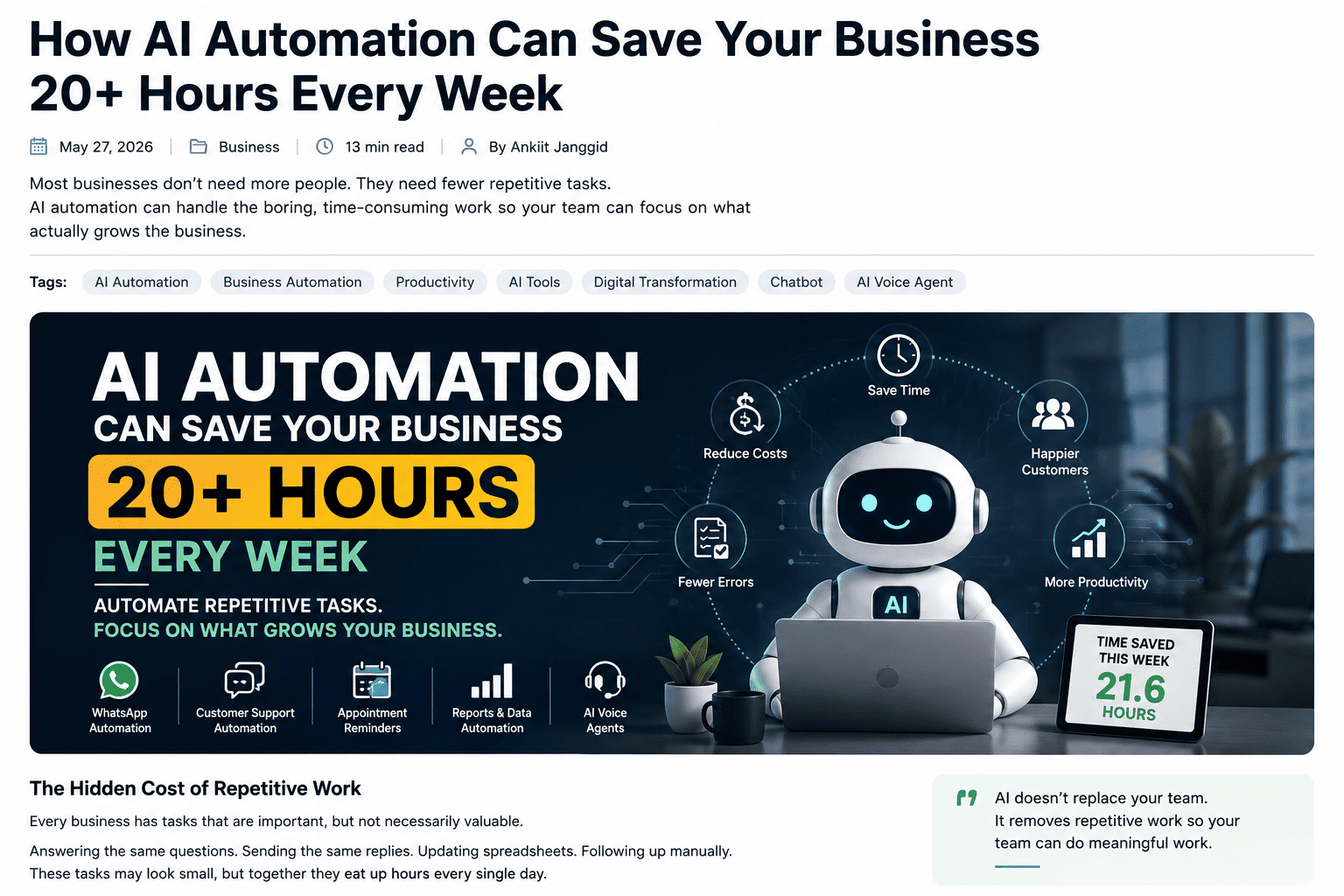
How AI Automation Can Save Your Business 20+ Hours Every Week
AI automation can handle repetitive business tasks, reduce manual work, and give your team more time to focus on customers, sales, and growth. Here's where AI can make the biggest difference.
How AI Automation Can Save Your Business 20+ Hours Every Week
Most businesses don't necessarily need more employees.
Sometimes, they simply need fewer repetitive tasks.
Think about how much time your team spends every week doing things like:
- Answering the same customer questions
- Following up with leads
- Sending appointment reminders
- Updating spreadsheets
- Copying information between systems
- Creating reports
- Sending repetitive WhatsApp messages
- Checking whether customers have responded
Each task might take only a few minutes.
But when you add them together, they can consume dozens of hours every week.
This is where AI automation can make a real difference.
The Hidden Cost of Repetitive Work
Every business has work that is important but doesn't necessarily require human creativity.
Someone has to answer the customer.
Someone has to send the reminder.
Someone has to update the record.
Someone has to generate the report.
Someone has to follow up.
The problem isn't that these tasks are difficult.
The problem is that they happen again and again.
For example, imagine a business receives 100 customer inquiries every day.
If an employee spends only three minutes handling each basic inquiry, that's:
300 minutes every day.
That's 5 hours every day spent answering basic questions.
Over a month, that's more than 100 hours.
And that's just one workflow.
Where Can AI Automation Help?
AI isn't useful because it sounds futuristic.
It's useful when it removes repetitive work.
Here are some practical examples.
1. Customer Support Automation
A large percentage of customer questions are repetitive.
Customers might ask:
- What are your prices?
- What are your working hours?
- Where are you located?
- How can I book?
- What documents do I need?
- When will my order arrive?
An AI assistant can answer these questions instantly.
For more complex questions, it can hand the conversation over to a human.
The goal isn't to eliminate human support.
It's to make sure your employees don't spend their entire day answering questions that have already been answered hundreds of times.
2. WhatsApp Automation
For many businesses, WhatsApp is already one of the primary communication channels.
Instead of having employees manually respond to every message, businesses can automate parts of the conversation.
For example:
Customer: "I want to book an appointment."
AI: "Sure. What day would you prefer?"
The system can then:
- Check availability.
- Collect customer information.
- Confirm the appointment.
- Send a confirmation message.
- Send a reminder before the appointment.
A process that previously required several manual steps can become almost completely automated.
3. Lead Qualification
Not every lead deserves the same amount of sales time.
AI can ask initial questions and collect information such as:
- Name
- Business type
- Budget
- Requirements
- Timeline
- Location
The system can then categorize leads.
For example:
Hot Lead
Ready to buy and meets the required criteria.
Warm Lead
Interested but needs more information.
Cold Lead
Not currently ready.
Your sales team can then spend more time talking to qualified prospects instead of manually sorting every inquiry.
4. Automated Follow-Ups
One of the biggest problems in sales is not following up consistently.
A potential customer says:
"I'll think about it."
The salesperson gets busy.
Three days pass.
Then a week.
The opportunity is forgotten.
Automation can help.
For example:
Day 1: Initial follow-up
Day 3: Send additional information
Day 7: Follow up again
Day 14: Final reminder
The system can notify a salesperson when human intervention is required.
This doesn't replace salespeople.
It makes sure opportunities don't disappear simply because someone forgot to follow up.
5. Appointment Reminders
Businesses lose time and revenue because customers forget appointments.
AI-powered automation can send:
- Confirmation messages
- Reminder messages
- Rescheduling options
- Cancellation instructions
For example:
"Hi Ankit, this is a reminder that your appointment is tomorrow at 3 PM. Reply 1 to confirm or 2 to reschedule."
This is simple automation, but it can have a measurable impact on operations.
6. Reports and Data Automation
Many businesses still create reports manually.
Someone exports data.
Someone cleans it.
Someone puts it into Excel.
Someone creates charts.
Someone emails the report.
This can take hours.
Automation can collect information from your systems and generate reports automatically.
For example:
Every Monday at 9 AM
The management team receives:
- Sales summary
- New customers
- Pending payments
- Conversion rate
- Top-performing products
- Outstanding tasks
Instead of spending Monday morning preparing reports, the team can spend it acting on the information.
7. AI Voice Agents
AI automation isn't limited to text.
Voice agents can also handle certain business conversations.
For example:
- Appointment booking
- Customer inquiries
- Lead qualification
- Order status
- Reminders
- Basic support
A customer can call a business and speak with an AI voice agent.
The agent can understand the request, retrieve information, and perform an action.
If the conversation becomes too complex, it can transfer the customer to a human.
This can be particularly useful for businesses receiving a high volume of repetitive calls.
How Much Time Can You Actually Save?
The exact number depends on the business.
But you can estimate the potential savings by looking at repetitive tasks.
For example:
| Task | Current Time/Week | Automated Time/Week |
|---|---|---|
| Customer inquiries | 10 hrs | 2 hrs |
| Lead follow-ups | 6 hrs | 1 hr |
| Appointment reminders | 3 hrs | 30 min |
| Reports | 5 hrs | 1 hr |
| Data entry | 6 hrs | 2 hrs |
That's:
30 hours → 6.5 hours
Potentially saving more than 23 hours every week.
The important point is that you don't need to automate everything.
Automating a few high-volume workflows can already create significant savings.
AI Doesn't Replace Your Team
This is probably the biggest misconception around AI automation.
The goal shouldn't always be:
"How many employees can AI replace?"
A better question is:
"How much repetitive work can we remove from our employees?"
Imagine an employee currently spends four hours every day answering basic questions.
If AI reduces that to one hour, the employee hasn't become unnecessary.
They now have three additional hours to:
- Talk to important customers
- Solve difficult problems
- Improve processes
- Generate sales
- Work on strategic tasks
That's where the real value comes from.
When AI Automation Is NOT Worth It
Not every process should be automated.
Don't automate something simply because you can.
Automation may not be worthwhile when:
- The task happens only a few times a month.
- The workflow is constantly changing.
- Human judgment is essential.
- The cost of automation exceeds the savings.
- The process is already very simple.
- Customers specifically expect human interaction.
Good automation starts with economics and business value—not technology.
Start With One Workflow
You don't need to transform your entire business overnight.
In fact, I recommend the opposite.
Start with one repetitive process.
For example:
Step 1: Identify a task that happens every day.
Step 2: Measure how much time employees spend on it.
Step 3: Determine whether AI can handle part or all of the process.
Step 4: Automate it.
Step 5: Measure the results.
Step 6: Move to the next workflow.
This makes automation easier to manage and gives you measurable results.
The Best Automation Is Invisible
Good automation shouldn't make your business more complicated.
Customers shouldn't have to understand that AI is involved.
Employees shouldn't have to fight with a complicated system.
The best automation simply makes things happen.
A customer gets an answer.
A lead gets followed up.
An appointment gets confirmed.
A report appears in someone's inbox.
A payment reminder gets sent.
Nobody thinks about the automation.
They simply notice that the business works better.
Final Thoughts
AI automation isn't about replacing people with robots.
It's about removing repetitive work that doesn't need to be done manually.
Every business has processes that consume time without creating much additional value.
Those processes are opportunities.
Start small.
Find one repetitive workflow.
Automate it.
Measure the result.
Then keep improving.
You might discover that your business doesn't need more people to handle the workload.
It simply needs better systems.
AI should not replace the people who grow your business.
It should remove the work that prevents them from doing it.

Ankiit Janggid
Technical consultant and developer focused on engineering guidance, APIs, AI, and scalable product delivery.
View profile