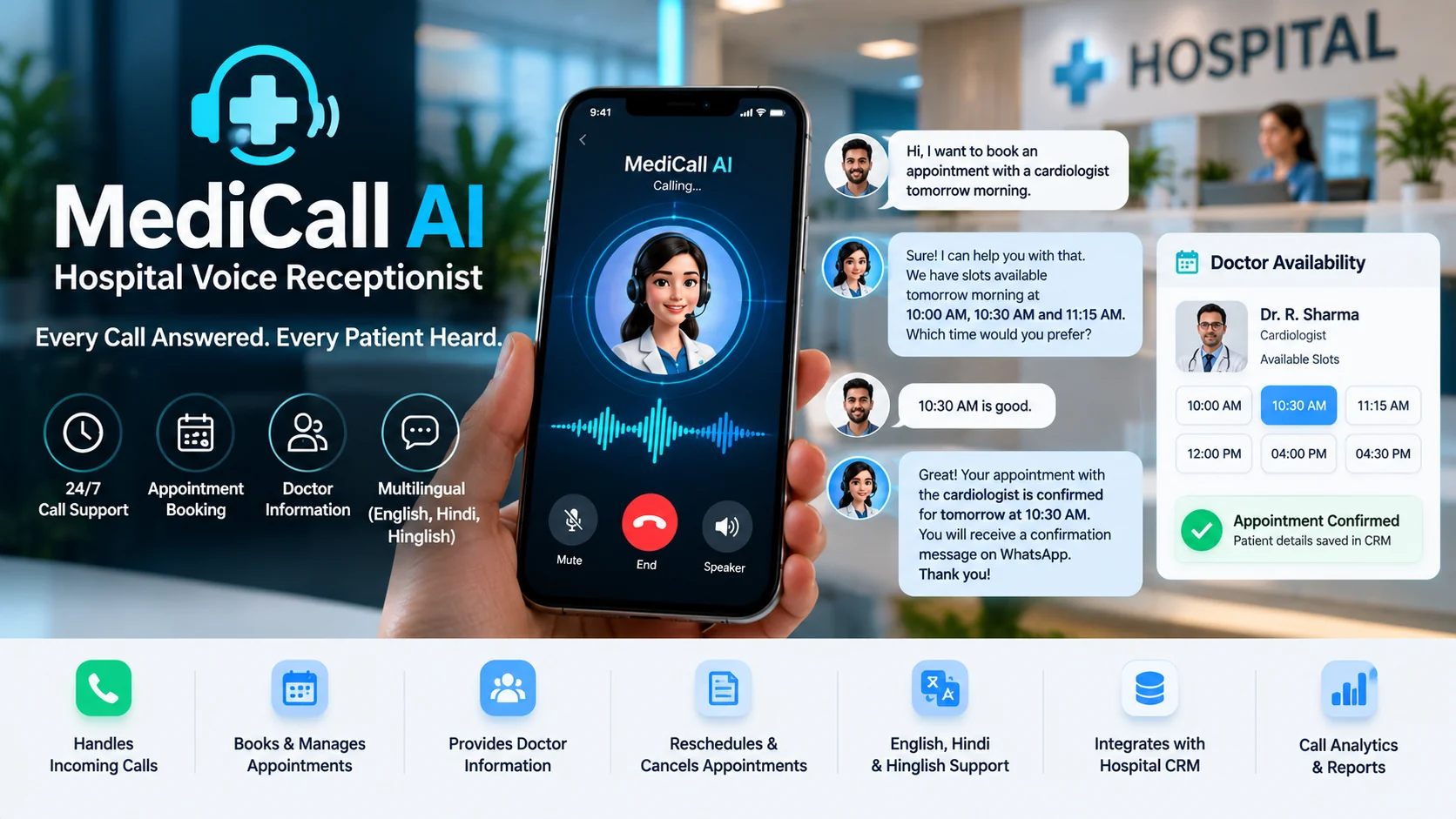
MediCall AI – Intelligent Hospital Voice Receptionist
Healthcare AI / Voice Automation
MediCall AI – Intelligent Hospital Voice Receptionist
Project Overview
MediCall AI is an AI-powered hospital voice receptionist concept designed to automate routine patient phone conversations and simplify hospital reception operations.
The solution uses conversational artificial intelligence to interact with patients through natural voice calls.
Instead of waiting for a human receptionist to answer every enquiry, patients can speak with an AI voice assistant to obtain hospital information, request appointments, check doctor availability, and receive booking confirmations.
The system is designed to support English, Hindi, and Hinglish conversations, making it suitable for hospitals, clinics, and healthcare facilities serving multilingual patients.
Core Concept: Patient Calls → AI Answers → Understands Request → Performs Action → Updates Hospital CRM
The Challenge
Hospital reception teams handle numerous phone calls throughout the day.
These conversations frequently involve repetitive questions about:
-
Doctor availability.
-
Appointment booking.
-
Consultation timings.
-
Hospital operating hours.
-
Department information.
-
Appointment rescheduling.
-
Appointment cancellations.
-
Consultation fees.
-
Hospital location and directions.
During busy hours, reception teams may struggle to respond to every call promptly.
Missed calls can result in missed appointment opportunities, while repetitive enquiries increase the administrative workload.
The objective of MediCall AI is to automate routine reception calls while ensuring that complex or sensitive conversations can be transferred to hospital staff.
The Proposed Solution
MediCall AI introduces an intelligent voice-calling agent that acts as a virtual hospital receptionist.
When a patient calls the hospital, the AI assistant answers and begins a natural conversation.
The assistant identifies the caller's intent, retrieves relevant information from approved hospital records, and performs permitted actions through connected systems.
For example, a patient may say:
"Hello, mujhe kal dermatologist ka appointment book karna hai."
The AI understands that the patient wants to book a dermatologist appointment for tomorrow.
It checks the connected appointment system, identifies available slots, and asks the patient to select a convenient time.
After the patient confirms, the system creates the appointment and provides confirmation.
Key Features
1. AI-Powered Incoming Call Handling
The AI receptionist answers incoming hospital calls and assists patients with routine enquiries.
2. Natural Voice Conversations
Patients can communicate naturally without navigating complicated telephone menus.
3. Multilingual Voice Support
Designed to understand and respond in English, Hindi, and Hinglish.
4. Doctor Availability Enquiries
Retrieves doctor schedules and available appointment slots from the connected hospital system.
5. Automated Appointment Booking
Collects the necessary patient details, confirms the requested appointment, and creates a booking in the hospital management system.
6. Appointment Rescheduling
Allows patients to request appointment changes through voice conversations.
7. Appointment Cancellation
Supports cancellation requests after appropriate booking verification.
8. Hospital Information Assistance
Provides approved information about departments, hospital timings, consultation fees, and available services.
9. Patient Information Collection
Collects the minimum information necessary to process appointment requests.
10. Hospital CRM Integration
Connects voice conversations with hospital administration workflows to create and update appointment records.
11. Human Receptionist Handover
Transfers conversations to hospital staff when the AI cannot complete a request or when human assistance is required.
12. Call Activity Dashboard
Provides administrators with visibility into call activity, appointment requests, and automation performance.
How MediCall AI Works
Step 1: Patient Calls the Hospital
A patient dials the hospital's reception number.
Step 2: AI Receptionist Answers
The AI answers the call and introduces itself as a virtual assistant.
Example:
"Namaste! MediCall Hospital ke AI reception assistant mein aapka swagat hai. Main aapki kya madad kar sakta hoon?"
Step 3: Patient Explains the Requirement
The patient speaks naturally.
Example:
"Mujhe kal subah Dr. Sharma ka appointment chahiye."
Step 4: AI Understands the Request
The system uses speech recognition and natural language understanding to identify:
-
Requested doctor.
-
Preferred appointment date.
-
Preferred appointment time.
-
Type of assistance required.
Step 5: Check Doctor Availability
The AI retrieves available appointment slots from the hospital's scheduling system.
Step 6: Confirm Appointment Details
The assistant presents available options and asks the patient to confirm the selected appointment.
Step 7: Create Appointment
After confirmation, the application creates the appointment through the hospital management API.
Step 8: Provide Confirmation
The AI communicates the booking details to the patient.
An SMS or WhatsApp confirmation can also be sent when configured and permitted.
Example Voice Conversation
AI Receptionist:
"Namaste! Welcome to MediCall Hospital. How may I assist you today?"
Patient:
"Mujhe kal cardiologist ka appointment book karna hai."
AI Receptionist:
"Ji zaroor. Aap kal morning mein appointment chahenge ya evening mein?"
Patient:
"Morning mein."
AI Receptionist:
"Kal morning mein 10:30 aur 11:15 ke slots available hain. Aap kaunsa time prefer karenge?"
Patient:
"10:30."
AI Receptionist:
"Ji. Appointment book karne ke liye aapka naam aur mobile number bata dijiye."
Patient:
"Mera naam Rahul Sharma hai."
AI Receptionist:
"Thank you. Main aapki details confirm karke appointment book kar deti hoon."
System Action:
The AI verifies the required details, checks availability again, and creates the appointment after confirmation.
AI Receptionist:
"Aapka appointment kal subah 10:30 baje confirm ho gaya hai. Thank you!"
This is an illustrative conversation showing the intended functionality, not an actual recorded call.
Proposed Technical Architecture
The system can be developed using a modular architecture connecting telephony, speech recognition, AI processing, and hospital management services.
1. Telephony Integration
Twilio or Exotel can be used to receive and manage incoming hospital calls.
2. Speech-to-Text Processing
Deepgram can convert patient speech into text for AI processing.
3. Conversational AI
An LLM accessed through OpenRouter can interpret patient requests, maintain conversation context, and determine the next permitted action.
4. Text-to-Speech
A speech synthesis service can convert the AI's responses into natural-sounding voice output.
5. Backend Services
Node.js can manage conversation sessions, API integrations, appointment workflows, and business logic.
6. Database
PostgreSQL can store operational records, appointment information, and authorized call metadata.
7. Hospital Management Integration
REST APIs can connect the AI voice receptionist to the hospital's existing appointment scheduling and CRM systems.
8. Administration Dashboard
A web-based dashboard can help hospital staff manage appointments, review operational activity, and configure AI reception workflows.
Healthcare Safety & Privacy
Because the application handles healthcare-related conversations, privacy and safety are essential parts of its architecture.
The system should:
-
Clearly identify itself as an AI assistant.
-
Avoid diagnosing conditions or recommending medical treatments.
-
Transfer medical questions to qualified healthcare professionals.
-
Recognize emergency-related requests and direct callers to appropriate emergency services.
-
Verify identity before disclosing or modifying sensitive patient information.
-
Minimize the collection and storage of patient information.
-
Protect patient data through encryption and role-based access controls.
-
Apply appropriate consent and retention policies for call recordings and transcripts.
-
Maintain audit logs for sensitive administrative actions.
-
Follow applicable healthcare data protection requirements.
Expected Business Benefits
Reduced Reception Workload
Automates routine enquiries and appointment-related administrative tasks.
Improved Call Availability
Provides a foundation for round-the-clock handling of supported patient enquiries.
Faster Appointment Booking
Allows patients to request appointments through natural conversations.
Reduced Missed Enquiries
Helps hospitals manage calls when reception teams are busy.
Multilingual Accessibility
Supports communication in languages commonly used by patients.
Centralized Appointment Management
Connects patient calls directly with hospital scheduling workflows.
Scalable Reception Operations
Provides a foundation for handling multiple simultaneous calls as infrastructure capacity increases.
Future Development Opportunities
The platform could be extended with:
-
Outbound appointment reminder calls.
-
Follow-up appointment scheduling.
-
Multi-branch hospital support.
-
Department-specific AI assistants.
-
Automated missed-call callbacks.
-
Integration with electronic health record systems.
-
Real-time call analytics.
-
Appointment confirmation through WhatsApp.
-
Advanced call routing and escalation.
-
Multiple AI voice profiles.
Project Outcome
MediCall AI is envisioned as an intelligent hospital reception automation solution that combines conversational AI, voice processing, telephony, and hospital management integration.
The project aims to demonstrate how AI-powered voice agents can reduce repetitive administrative work and improve the accessibility of hospital reception services.
It also presents an opportunity to implement real-time voice processing, conversational state management, secure API integrations, appointment scheduling, and human handover workflows.
Project Status
Concept / Planned Development
The described capabilities represent the intended product scope and should be updated as individual features are implemented and tested.