AI & Automation
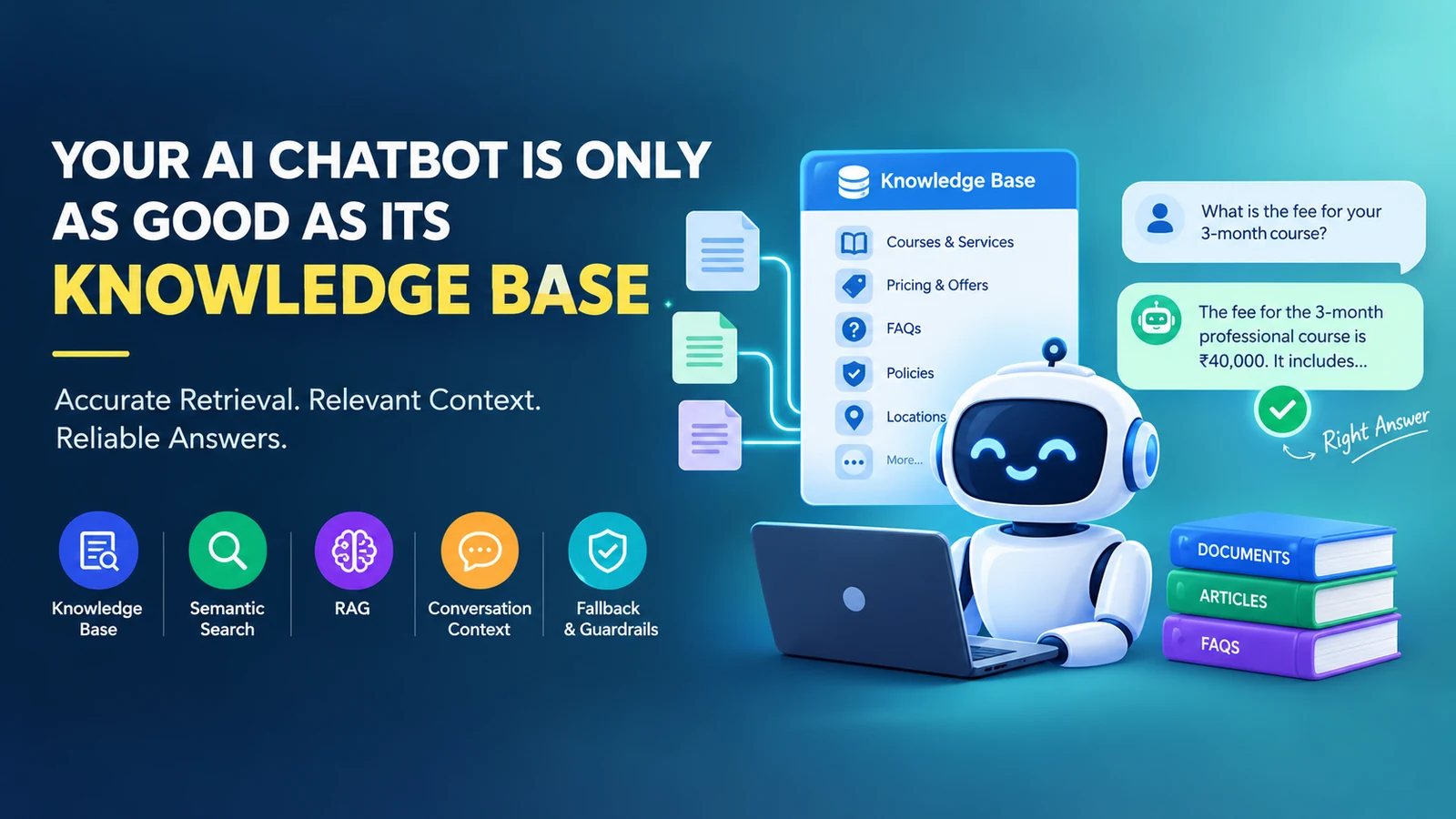
Your AI Chatbot Is Only as Good as Its Knowledge Base
An AI chatbot is only as reliable as the information it can access. Learn how knowledge bases, semantic search, retrieval-augmented generation, and proper fallback handling help businesses build more accurate and trustworthy AI assistants.
Your AI Chatbot Is Only as Good as Its Knowledge Base
Imagine a customer asking your AI chatbot a simple question:
"What is the fee for your three-month course?"
The business offers several courses, each with different fees.
The chatbot responds confidently with a price.
But the price belongs to a different course.
The answer sounds convincing. The customer trusts it. And the business may lose credibility because of a mistake that could have been avoided.
This is one of the biggest challenges when building AI chatbots for real businesses.
A chatbot can use a powerful AI model and still provide incorrect answers if it retrieves the wrong information.
That's why building a reliable AI chatbot requires more than connecting an LLM to a messaging channel.
It requires a well-designed knowledge base, accurate retrieval, conversation context, and rules for handling questions the system cannot answer.
Let's look at how these pieces work together.
1. What Is a Knowledge Base?
A knowledge base is a structured collection of information an AI assistant uses to answer questions about a business.
It might contain:
-
Product and service details
-
Pricing and packages
-
Frequently asked questions
-
Company policies
-
Course descriptions
-
Branch locations
-
Eligibility requirements
-
Delivery and refund policies
-
Technical documentation
For example, a training academy might store information about course duration, fees, eligibility, locations, and available facilities.
When a customer asks a question, the chatbot searches the available information and uses relevant results to formulate an answer.
The quality of that answer depends partly on whether the right information is available and retrieved.
2. Why a Large Language Model Isn't Enough
Large language models are trained on large amounts of information, but they don't automatically know the current, private details of your business.
Your pricing may change next month. A branch may introduce a new course. Your refund policy may differ from another company's policy.
A general-purpose model cannot be expected to know those details accurately without access to reliable business information.
Giving the model a long prompt containing every document isn't always a good solution either. It can become expensive, difficult to maintain, and inefficient as the knowledge base grows.
A better approach is to retrieve the information relevant to each question.
This is where Retrieval-Augmented Generation, commonly known as RAG, becomes useful.
3. What Is Retrieval-Augmented Generation (RAG)?
RAG combines information retrieval with AI-generated responses.
Instead of asking the model to answer from its general knowledge alone, the system first searches a knowledge source for relevant information.
A simplified workflow looks like this:
Customer Question → Search Knowledge Base → Retrieve Relevant Information → Generate Answer → Respond to Customer
For example:
Customer: "Do you offer weekend classes?"
The system searches the academy's knowledge base and retrieves the section describing its class schedule.
The AI then generates an answer based on that information.
If the knowledge base confirms weekend classes are available, the chatbot can explain the schedule.
If no reliable information is found, the system should avoid inventing an answer.
RAG doesn't guarantee correctness, but it gives the model relevant information to work with.
4. Why Keyword Search Isn't Always Enough
Suppose your knowledge base contains this entry:
"Professional bartending program with practical training and industry-focused modules."
A customer asks:
"I want to learn how to work behind a bar professionally. Which course should I take?"
A simple keyword search may struggle because the customer didn't use the same words as the document.
This is where semantic search can help.
Semantic search attempts to identify information based on meaning rather than relying only on exact keyword matches.
The system can recognize that "work behind a bar professionally" may relate to "professional bartending."
This can improve retrieval when customers use different wording, spelling variations, or conversational language.
However, semantic similarity alone isn't sufficient. A document can be semantically related without containing the exact answer.
A reliable system must distinguish between information that is related and information that actually answers the question.
5. How Embeddings and Vector Search Work
Semantic search often uses embeddings.
An embedding converts text into a numerical representation that captures aspects of its meaning.
For example, these phrases may have similar representations:
-
"How much does the course cost?"
-
"What are the course fees?"
-
"Tell me the price of the program."
The system can compare the question's embedding with embeddings stored for knowledge-base content.
A vector database or another vector-search implementation can then retrieve nearby results.
A typical preparation process looks like this:
-
Collect business documents.
-
Extract their text.
-
Divide the text into manageable chunks.
-
Generate embeddings for those chunks.
-
Store the embeddings and associated metadata.
-
Search for relevant chunks when a question arrives.
-
Pass the selected information to the AI model.
Metadata is important too.
A chunk might be associated with a particular course, branch, product, or workspace.
Those attributes can help prevent information from one context being incorrectly used in another.
6. Why Chunking Matters
Imagine uploading a 100-page document as one large knowledge entry.
A customer's question about a single pricing detail may retrieve the entire document, including unrelated information.
That creates unnecessary noise.
Chunking divides documents into smaller sections that can be searched independently.
For example, a course document might be organized into sections covering:
-
Course overview
-
Eligibility
-
Duration
-
Fees
-
Class schedule
-
Certification
If someone asks about fees, the system can retrieve the pricing section rather than an entire document.
But chunking requires care.
Chunks that are too small may lose important context. Chunks that are too large may contain several unrelated topics.
The right approach depends on document structure, question types, and retrieval performance.
For structured information such as prices, course IDs, and branch-specific availability, explicit metadata and structured database queries may be more reliable than semantic search alone.
7. The Most Similar Result Isn't Always the Correct Answer
This is a subtle but important problem.
Suppose a business offers:
-
A one-month introductory course
-
A three-month professional course
-
A six-month advanced course
A customer asks:
"What is the fee for the three-month professional course?"
The retrieval system returns information about the six-month advanced course because the descriptions are very similar.
The model now has relevant-looking information, but it is about the wrong course.
If the system doesn't verify the requested course, it may return the wrong price.
This is why retrieval quality should be evaluated against the actual question, not just whether the retrieved text looks related.
Useful safeguards include:
-
Matching the requested product or course explicitly
-
Applying branch or category filters
-
Preserving the original document's metadata
-
Ranking results using relevance and answerability
-
Rejecting results that don't support the requested fact
-
Asking a clarifying question when the request is ambiguous
For critical facts, structured queries can provide an additional layer of protection.
8. Conversation Context Changes the Search
Customers rarely ask every question in isolation.
Consider this conversation:
Customer: "Tell me about the professional bartending course."
AI: "It covers practical bartending skills and industry-focused training."
Customer: "What is the fee?"
The second question doesn't identify the course.
The system needs to remember that the customer is asking about the professional bartending course.
Now consider a topic change:
Customer: "What is the fee?"
AI: "The fee depends on the course. Which one are you interested in?"
Customer: "Actually, tell me about the advanced course."
The system must update its understanding of the current topic rather than blindly carrying forward the earlier course.
Good conversational AI therefore needs two things:
-
Conversation memory to understand what the customer means.
-
Retrieval logic to find the correct supporting information.
Memory without accurate retrieval can produce confident mistakes. Retrieval without context can return information about the wrong topic.
Both matter.
9. What Should Happen When the Answer Is Missing?
A production chatbot needs a deliberate fallback strategy.
Imagine a customer asks:
"Does the Jaipur branch provide hostel accommodation?"
The knowledge base contains course details and fees but no confirmed accommodation policy.
The chatbot should not infer that accommodation is available simply because other academies offer it.
A safer response would be:
"I don't have confirmed information about accommodation at the Jaipur branch. I can help you get this verified by the team."
The system can also record the unanswered question for review.
A useful fallback process is:
-
Search the knowledge base.
-
Check whether the retrieved information supports the answer.
-
Ask for clarification if the question is ambiguous.
-
Escalate when the answer cannot be verified.
-
Record the missing information.
-
Add an approved answer after the business confirms it.
The goal isn't to answer every question at any cost.
The goal is to provide reliable answers and handle uncertainty responsibly.
10. Keep the Knowledge Base Up to Date
Even a well-designed retrieval system will struggle with outdated information.
Imagine the business changes its course fees, but the old document remains published.
The chatbot may retrieve the old price and return it accurately according to the document, while still giving the customer incorrect information.
Businesses need a process for maintaining knowledge.
That may include:
-
Assigning an owner to important information
-
Reviewing pricing and policies periodically
-
Tracking document versions
-
Removing or archiving outdated entries
-
Reprocessing embeddings when content changes
-
Testing important questions after updates
-
Keeping published information separate from drafts
For time-sensitive information, the system should prefer the current approved source rather than whichever document happens to be most similar to the question.
11. How to Evaluate an AI Knowledge Base
Don't evaluate a chatbot by asking a few easy questions and deciding that it works.
Build a test set based on real customer conversations.
Include questions such as:
-
Direct questions with answers available
-
Questions phrased in different ways
-
Questions containing spelling mistakes
-
Questions that depend on previous messages
-
Questions involving specific products or locations
-
Questions where the answer is missing
-
Questions that could match multiple documents
-
Questions that change the subject mid-conversation
For each test, check:
Retrieval quality: Did the system find the right information?
Answer accuracy: Does the response match the source?
Context handling: Did it interpret the conversation correctly?
Fallback quality: Did it avoid guessing when evidence was missing?
Scope control: Did it use information from the correct product, branch, or workspace?
Latency and cost: Can the system answer within acceptable time and budget?
These tests make improvement measurable rather than subjective.
12. A Practical Architecture for a Business AI Chatbot
A basic production architecture might look like this:
WhatsApp or Website Chat
↓
Message Handler
↓
Intent and Conversation Context
↓
Knowledge Retrieval
↓
Relevance and Scope Validation
↓
AI Response Generation
↓
Safety and Answerability Checks
↓
Customer Response or Human Handover
The surrounding application also manages conversation state, workspace boundaries, API integrations, logging, and operational monitoring.
Not every message needs the same processing path.
A request to check an order status may require an authenticated database or API lookup. A question about a refund policy may require document retrieval. A request to speak with a person may need immediate escalation.
Routing questions to the right source is often just as important as choosing the AI model.
Final Thoughts
Building an AI chatbot is easy to describe: connect a messaging channel to an AI model and start answering questions.
Building one that a business can trust is a different challenge.
The system needs accurate information, useful retrieval, relevant context, controlled responses, and a clear strategy for unanswered questions.
Semantic search can help find information expressed in different words. RAG can ground responses in business documents. Metadata can keep results within the correct scope. Structured queries can protect critical facts. Human handover can resolve questions the system cannot confidently answer.
No single technique solves every problem.
The strongest systems combine these methods according to the task.
Don't focus only on making your AI chatbot smarter. Focus on helping it find the right information, understand the question, and recognize when it doesn't know the answer.
That's how you move from an impressive demo to a useful business system.

Ankiit Janggid
Technical consultant and developer focused on engineering guidance, APIs, AI, and scalable product delivery.
View profile