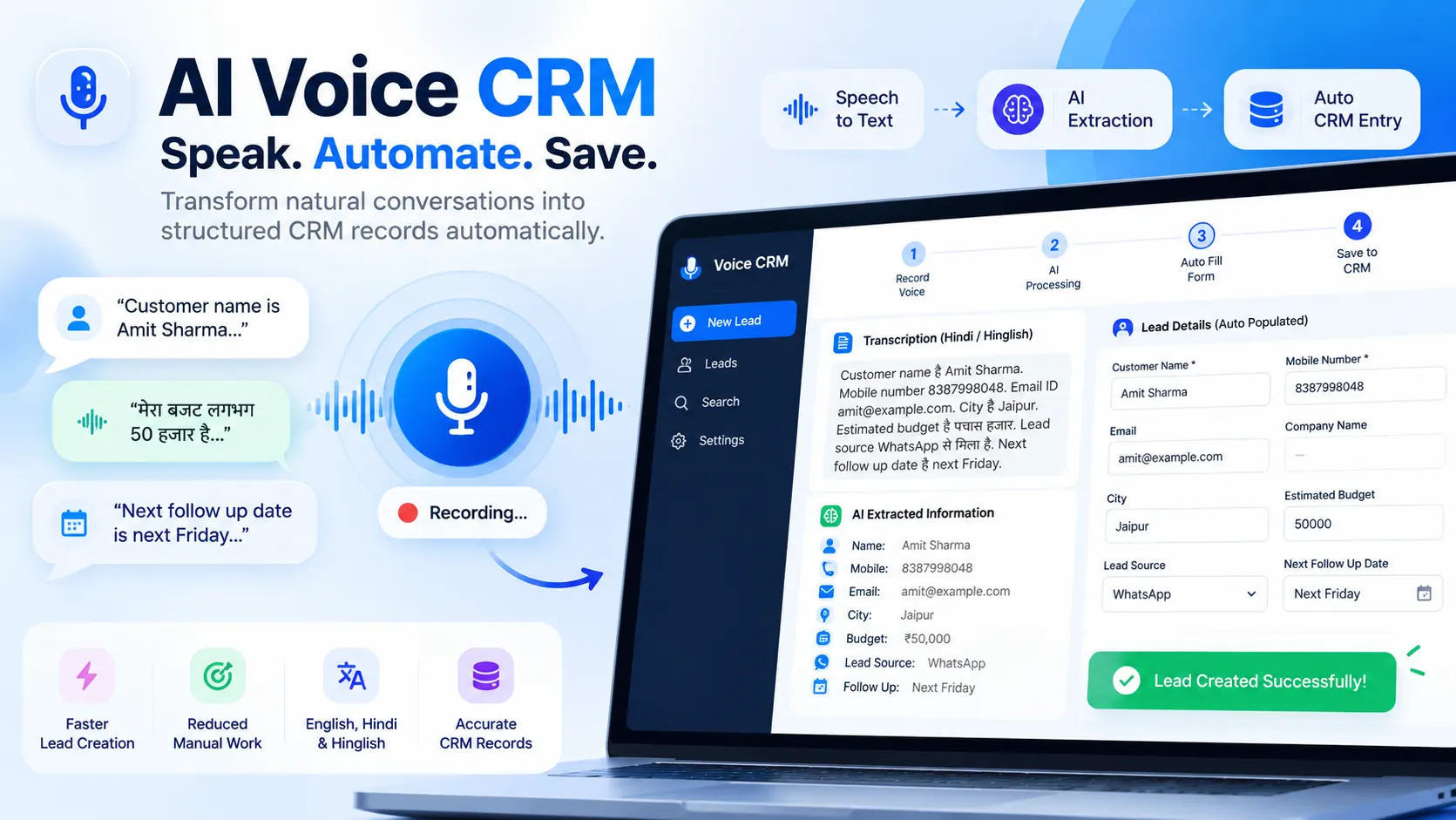
AI Voice CRM – Intelligent Voice-to-Data Automation
Artificial Intelligence / CRM Automation
AI Voice CRM – Intelligent Voice-to-Data Automation
Project Overview
AI Voice CRM is an intelligent, voice-powered CRM automation solution designed to eliminate repetitive manual data entry and simplify business workflows.
The system allows users to interact with CRM forms using natural voice instructions instead of manually typing information into multiple fields.
By combining speech-to-text technology, large language models (LLMs), and structured data extraction, the application converts spoken conversations into organized CRM records.
The solution supports English, Hindi, and Hinglish, making it practical for businesses where employees communicate naturally in multiple languages.
The Challenge
Traditional CRM systems require users to manually enter customer information into multiple form fields.
For sales teams, customer support executives, and field representatives, this process can be repetitive and time-consuming.
Common challenges include:
-
Manual entry of customer information.
-
Repetitive form-filling activities.
-
Switching between customer conversations and CRM screens.
-
Difficulty capturing information during live conversations.
-
Managing multilingual customer enquiries.
-
Incomplete or inconsistent lead records.
-
Additional administrative effort after customer interactions.
The objective was to simplify CRM interactions by allowing users to communicate with the system through natural speech.
The Solution
An AI-powered voice automation workflow was developed to capture spoken information, understand its meaning, extract relevant details, and populate CRM forms automatically.
Instead of manually filling out fields such as customer name, mobile number, email, city, budget, and follow-up date, users can provide this information through a natural conversation.
The application processes the recording and transforms the extracted information into structured data.
Once the information is validated, the system can automatically submit the completed form and create a CRM record.
Key Features
1. Voice-Based CRM Data Entry
Users can provide customer information through voice instructions without manually typing into individual form fields.
2. Multilingual Speech Recognition
Supports conversations in English, Hindi, and Hinglish, allowing users to communicate naturally.
3. AI-Powered Information Extraction
Uses large language models to identify important information from conversational speech and map it to CRM fields.
4. Automatic Form Population
Extracted customer details are automatically populated into the corresponding CRM form fields.
5. Intelligent Lead Capture
Captures structured information such as:
-
Customer name
-
Mobile number
-
Email address
-
Company name
-
City
-
Estimated budget
-
Lead source
-
Customer requirements
-
Follow-up date
6. Automated Form Submission
After successful extraction and validation, the system can automatically submit the form and save the CRM record.
7. Editable CRM Records
Users can review, edit, and update previously saved information when corrections are required.
8. Voice Transcription
Displays the recognized speech transcript, providing visibility into the information captured from the conversation.
9. Data Validation
Validates extracted information before saving it to the database.
10. Modular CRM Integration Concept
Designed with the goal of extending voice-powered data entry across different CRM modules and form structures.
How the System Works
Step 1: Start Voice Recording
The user clicks the microphone button and begins speaking naturally.
Example:
"Create a new lead for Rahul Sharma. His mobile number is 9876543210. He needs a business website with a budget of fifty thousand rupees. Schedule the next follow-up for Friday."
Step 2: Speech-to-Text Conversion
The recorded audio is processed using Deepgram's speech recognition API.
The system converts spoken language into a text transcript.
Step 3: AI Information Extraction
The transcript is sent to an LLM through OpenRouter.
The AI analyzes the conversation and identifies the information relevant to the CRM form.
Step 4: Structured Data Generation
The extracted information is converted into structured JSON data.
Example:
{
"customer_name": "Rahul Sharma",
"mobile_number": "9876543210",
"requirement": "Business Website",
"estimated_budget": 50000,
"follow_up": "Friday"
}
Step 5: Automatic Form Population
The application maps the structured information to the corresponding CRM fields.
Step 6: Validation and Submission
The system validates required fields and automatically saves the record when the necessary information is available.
Step 7: CRM Record Management
Saved records can be accessed, searched, edited, and managed through the CRM interface.
Technical Implementation
The project combines multiple technologies to create an end-to-end voice automation workflow.
Speech Recognition
Deepgram API processes recorded audio and converts multilingual speech into text.
AI Processing
OpenRouter provides access to large language models responsible for understanding conversational instructions and extracting structured information.
Backend Processing
Node.js handles audio processing requests, API communication, structured data validation, and database operations.
Database
SQLite provides persistence for CRM lead records in the standalone implementation.
Frontend
A browser-based interface provides audio recording, transcription display, form population, and record management functionality.
API Integration
REST APIs connect the frontend, backend, speech recognition service, and AI processing components.
Engineering Highlights
-
Speech-to-text API integration.
-
LLM-based structured data extraction.
-
Natural language understanding.
-
Multilingual voice processing.
-
Dynamic form population.
-
Automated record creation.
-
Server-side data validation.
-
Database persistence.
-
Asynchronous API processing.
-
Error handling and retry workflows.
-
Modular architecture for future CRM integration.
Business Benefits
Reduced Manual Data Entry
Users can capture customer information through natural conversations rather than manually completing every field.
Faster Lead Creation
Customer details can be extracted and organized into CRM records through a single voice interaction.
Improved User Experience
Voice-based interaction makes CRM data entry more convenient for sales representatives and operational teams.
Multilingual Accessibility
English, Hindi, and Hinglish support makes the system suitable for multilingual business environments.
Consistent Data Structure
AI extraction helps organize unstructured conversations into standardized CRM fields.
Scalability Potential
The architecture provides a foundation for extending voice automation to additional CRM modules and business workflows.
Future Development Scope
The solution can be expanded to support:
-
Voice-based updates to existing CRM records.
-
Multi-step form automation.
-
Dynamic field mapping across different modules.
-
Voice-driven search and filtering.
-
CRM task creation.
-
Follow-up scheduling.
-
Voice-based customer support workflows.
-
Integration with enterprise CRM platforms.
Project Outcome
AI Voice CRM demonstrates how speech recognition and large language models can transform traditional business applications into intelligent, voice-enabled systems.
The project establishes a practical foundation for reducing manual CRM data entry and enabling more natural interactions between users and business software.
It showcases hands-on experience in AI integration, API orchestration, natural language processing, backend development, and workflow automation.
Project Availability
This project is currently showcased as a standalone proof of concept.
The architecture is designed to support future integration with existing CRM systems and business applications.