Business
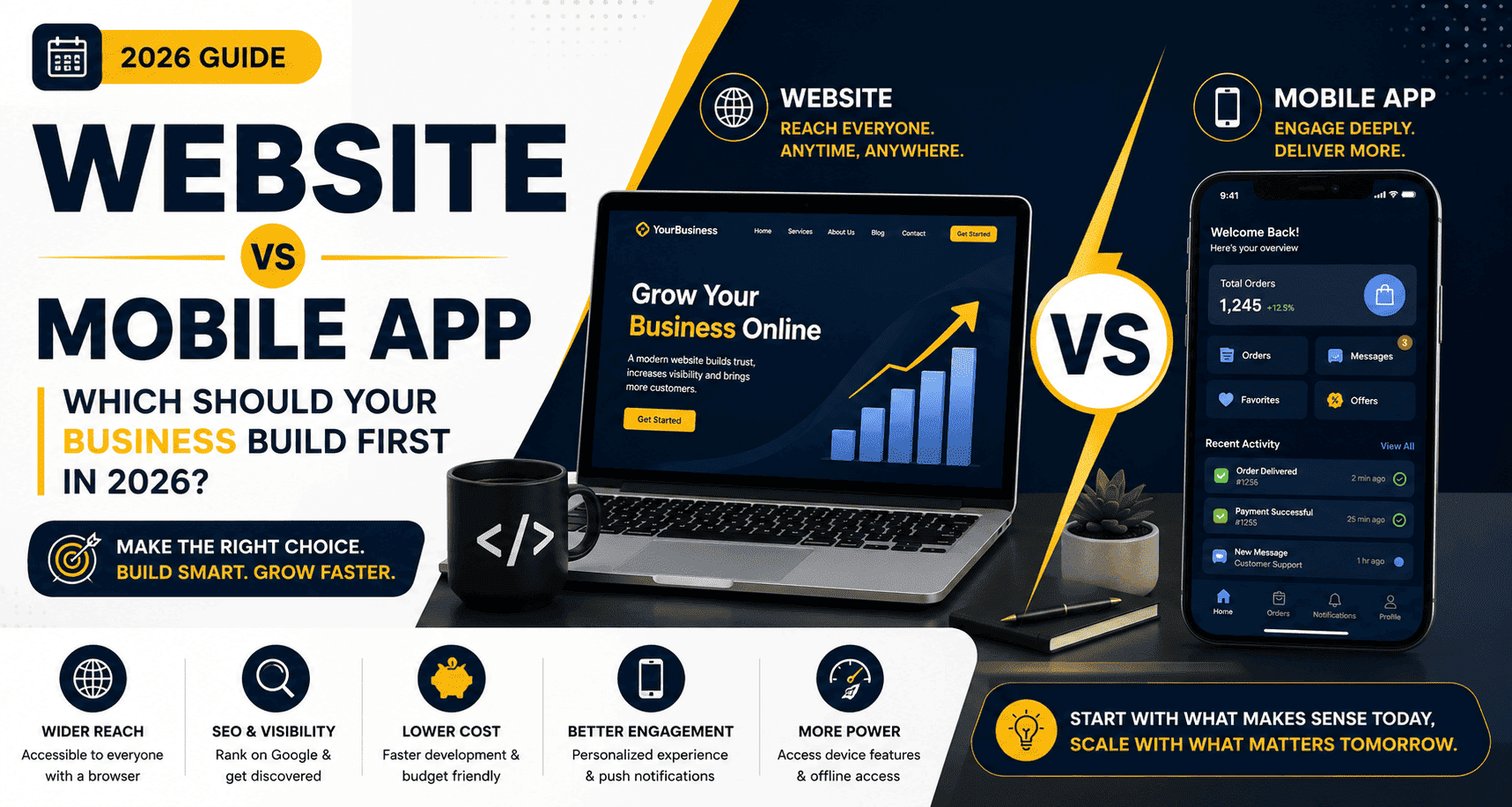
Website vs Mobile App: Which Should Your Business Build First in 2026?
Not sure whether your business needs a website or a mobile app first? This practical guide compares cost, accessibility, user experience, maintenance, and business goals to help you decide what to build first.
Website vs Mobile App: Which Should Your Business Build First in 2026?
One of the most common questions businesses ask when starting a new digital project is:
"Should we build a website or a mobile app?"
For many businesses, the immediate answer seems to be:
"We need an app."
But do you really?
A mobile app can be powerful, but it isn't automatically the best starting point for every business.
Depending on your audience, business model, budget, and product requirements, starting with a website or web application may actually be the smarter decision.
Let's break it down.
First, Understand the Difference
A website is accessible through a browser. Users can find it through Google, open a link, and start using it immediately.
A mobile app needs to be downloaded and installed from an app store.
Both have advantages.
The question isn't which technology is better.
The real question is:
Which one makes more sense for your users and your business right now?
When Should You Build a Website First?
For most new businesses and startups, I usually recommend starting with a website or web application.
Here's why.
1. Your Users Can Access It Instantly
A website doesn't require installation.
Someone can discover your business through:
- Social media
- Online advertising
- A shared link
One click, and they're there.
With a mobile app, users first need to visit an app store, download the application, install it, and then open it.
Every additional step creates friction.
2. Websites Are Better for Search Visibility
If customer acquisition through Google is important to your business, a website is essential.
Search engines can index your pages and help potential customers discover your business when searching for relevant products or services.
A mobile app alone doesn't provide the same level of search visibility.
For businesses that depend on organic traffic, content marketing, or local searches, starting with a website often makes more sense.
3. Development Is Usually Faster and More Affordable
Building and maintaining one responsive website is generally simpler than developing separate experiences for multiple mobile platforms.
A website works across:
- Desktop
- Laptop
- Tablet
- Android
- iPhone
With responsive design, you can serve users across devices from a single platform.
For businesses with limited budgets, this can significantly reduce initial development costs.
4. Updates Are Easier
When you update a website, the changes can become available to users immediately.
Mobile apps may require new versions, testing, app store submissions, and user updates.
For products that change frequently, web applications can provide greater flexibility during the early stages.
When Does a Mobile App Make More Sense?
There are situations where building a mobile app is absolutely the right decision.
1. Users Interact With Your Product Frequently
If customers use your service multiple times a day or several times a week, an app can provide a better experience.
Examples include:
- Banking
- Food delivery
- Fitness tracking
- Messaging
- Transportation
- Productivity tools
Frequent usage makes installing an app worthwhile.
2. You Need Mobile Device Features
Mobile apps can provide deeper access to device capabilities such as:
- Camera
- GPS
- Bluetooth
- Biometrics
- Push notifications
- Sensors
- Background services
If these features are central to your product, a native or cross-platform mobile app may be necessary.
3. Push Notifications Are Important
Mobile apps allow businesses to communicate directly with users through push notifications.
This can be valuable for:
- Order updates
- Appointment reminders
- Offers
- Messages
- Important alerts
However, notifications should provide genuine value. Too many unnecessary notifications can quickly lead users to disable them—or uninstall the app entirely.
4. You Need a Highly Personalized Experience
Apps are excellent for products where users log in regularly and interact with personalized information.
For example:
- Customer dashboards
- Employee applications
- Student platforms
- Membership applications
- Healthcare platforms
- Financial applications
In these situations, an app can provide a smoother and more focused user experience.
Website vs Mobile App: Quick Comparison
| Factor | Website | Mobile App |
|---|---|---|
| Initial Cost | Generally Lower | Generally Higher |
| Development Time | Faster | Longer |
| Installation Required | No | Yes |
| Google Search Visibility | Strong | Limited |
| Device Features | Limited | Strong |
| Push Notifications | Limited | Strong |
| Frequent User Engagement | Good | Excellent |
| Updates | Instant | May Require App Updates |
| Accessibility | Any Browser | Installed Devices |
| Maintenance | Generally Simpler | More Complex |
What About Building Both?
Some businesses genuinely need both a website and a mobile app.
But that doesn't necessarily mean you need to build both on day one.
A common approach is:
Step 1: Build a website or web application.
Step 2: Launch and acquire users.
Step 3: Understand how customers actually use the product.
Step 4: Identify whether a mobile app would significantly improve their experience.
Step 5: Build the app based on real user behavior and validated requirements.
This approach can reduce risk and prevent unnecessary development costs.
The Mistake I Often See
I've seen businesses decide they need a mobile app simply because competitors have one.
But having an app doesn't automatically create engagement.
Ask yourself:
Why would someone install my app?
And more importantly:
Why would they keep it installed?
If users only interact with your business once every few months, asking them to install an app may not make sense.
A fast, well-designed mobile website could provide everything they need.
Start With the Business Problem, Not the Technology
Instead of starting with:
"I want to build an app."
Start with:
"What problem am I trying to solve?"
Then ask:
- Who are my users?
- How often will they use the product?
- How will they discover it?
- Which features do they actually need?
- Do I need access to mobile hardware?
- What is my initial budget?
- How quickly do I need to launch?
The answers will usually make the right technology choice much clearer.
My Simple Rule
If you're launching a new business and still validating your idea, start with the simplest product that solves the core problem.
For many businesses, that's a website or web application.
If your users engage frequently, need device-specific features, or would genuinely benefit from an app experience, then investing in a mobile app makes sense.
And sometimes, the right answer is both.
But build both because your users need them—not because you feel every modern business needs an app.
Final Thoughts
A website and a mobile app are not competitors.
They're different tools designed for different purposes.
Your goal shouldn't be to choose the most impressive technology.
Your goal should be to choose the solution that delivers the most value to your customers while supporting your business goals.
Start simple.
Validate your idea.
Understand your users.
Then invest in technology based on real needs.
Because the best software decisions aren't driven by trends.
They're driven by problems worth solving.

Ankiit Janggid
Technical consultant and developer focused on engineering guidance, APIs, AI, and scalable product delivery.
View profile